Work-Activity Taxonomy
The table lists the 18 work activities derived from O*NET task statements. Counts are assigned task statements, not labor-market weights or deployment estimates.
| Work activity | Tasks | Definition | Example settings | Common proxies |
|---|---|---|---|---|
| analysis | 1,732 | Synthesize evidence into a supported finding or interpretation. | Research; finance. | Retrieval; summarization. |
| administration | 1,517 | Plan, allocate, or maintain organizational resources or processes. | Program management; operations. | Form filling; state tracking. |
| design | 992 | Specify a system, plan, artifact, or service to satisfy a goal. | Product design; architecture. | Plan generation; specification writing. |
| inspection | 963 | Check a current state against rules, standards, or specifications. | Compliance; safety review. | Classification; checklist scoring. |
| troubleshooting | 902 | Diagnose a problem and apply or recommend a remedy. | IT support; software debugging. | Log analysis; state repair. |
| record-keeping | 882 | Create, update, store, or retrieve canonical organizational records. | Clinical records; case files. | Extraction; database update. |
| teaching | 814 | Support a learner in acquiring knowledge or skill. | Tutoring; professional training. | Explanation; feedback generation. |
| procedure-execution | 735 | Carry out a prescribed procedure according to a standard. | Laboratory workflow; service procedure. | Policy following; checklist execution. |
| representation | 615 | Speak or act on behalf of an organization, client, or role. | Client communication; advocacy. | Role-play dialogue; policy-constrained response. |
| coordination | 603 | Align actors, constraints, dependencies, or timing around shared work. | Care coordination; logistics. | Scheduling; task routing. |
| creative-production | 543 | Produce an original creative, media, or communicative artifact to a brief. | Marketing; media production. | Copywriting; slide generation. |
| fabrication | 505 | Make, install, or maintain a tangible asset according to a work specification. | Construction planning; equipment setup. | Instruction generation; plan checking. |
| appraisal | 453 | Assess, grade, value, or judge an artifact or case against a standard. | Peer review; claims review. | Rubric scoring; preference judgment. |
| advising | 403 | Tailor a recommendation to a specific person, client, or case. | Clinical advice; financial advice. | Chat response; recommendation generation. |
| investigation | 377 | Reconstruct an event, condition, or pattern from evidence. | Fraud analysis; epidemiology. | Timeline reconstruction; evidence retrieval. |
| emergency-response | 212 | Stabilize or triage an acute incident under time pressure. | Clinical triage; incident response. | Triage classification; escalation decision. |
| self-study | 186 | Maintain or update one's working competency through learning. | Certification; continuing education. | Learning plan; self-assessment. |
| rule-enforcement | 30 | Apply or uphold behavioral or procedural rules in a setting. | Conduct review; safety enforcement. | Violation classification; escalation. |
The table should be read as a task-count inventory rather than a labor market estimate. Large categories such as analysis and administration contain many O*NET task statements, while smaller categories such as self-study and rule-enforcement remain important for agent evaluation because they mark different work products and review conditions.
O*NET Task Atlas
The atlas shows retained O*NET task statements, colored by work activity. Switch between 3D and 2D views. Hover over a point to see the source job, original task, normalized task label, work activity, work-activity cluster, and label color.
Result Summary
This page reports the work-activity results built from O*NET task statements and checked against ESCO skill and competence items. O*NET is the derivation source. ESCO is used as an external check because the two sources describe different units of work.
The main result is an intermediate vocabulary between narrow agent skills and broad occupations. Analysis and administration are the largest O*NET categories by task count. Smaller activities such as self-study and rule-enforcement remain part of the taxonomy because they describe different evidence, review, and handoff conditions.
Reading the Results
Work activity is used as the reporting unit because component tasks such as retrieval, summarization, or tool use are often too narrow, while domains and occupations are often too broad. The 18 labels give an intermediate vocabulary for describing what kind of work a task represents.
The atlas is a qualitative visualization of the retained O*NET task statements. Nearby points often share vocabulary and occupational context, but the layout is not a quantitative measure of work similarity. Disconnected regions with the same color show that the same work activity can appear in different occupational contexts.
Adjacent-Label Details
Some labels sit close to one another in task language. The distinctions below clarify what kind of product or review condition each label implies for agent evaluation.
| Work activity | Often confused with | Distinction for evaluation |
|---|---|---|
| analysis | investigation; appraisal | Analysis turns evidence into an interpretation. Investigation reconstructs an event or pattern. Appraisal judges an artifact or case against a standard. |
| administration | coordination; record-keeping | Administration maintains organizational resources and processes. Coordination aligns actors and dependencies. Record-keeping changes or retrieves canonical records. |
| design | creative-production; procedure-execution | Design specifies a system, plan, or artifact before use. Creative-production produces expressive output to a brief. Procedure-execution follows a prescribed standard. |
| inspection | appraisal; troubleshooting | Inspection checks a current state against rules. Appraisal assigns a judgment or value. Troubleshooting diagnoses a problem and applies or recommends a remedy. |
| advising | teaching; representation | Advising tailors a recommendation to a person or case. Teaching supports learning. Representation speaks or acts on behalf of a role, client, or organization. |
| fabrication | design; procedure-execution | Fabrication concerns tangible assets and physical work specifications. Design defines the plan. Procedure-execution concerns following a prescribed process. |
| emergency-response | troubleshooting; procedure-execution | Emergency-response involves acute stabilization or triage under time pressure. Troubleshooting may be slower diagnostic repair. Procedure-execution follows a standard path. |
| rule-enforcement | inspection; administration | Rule-enforcement applies behavioral or procedural rules in a setting. Inspection checks conformance. Administration maintains an organizational process. |
These distinctions matter for agents because adjacent labels imply different scored products. A final answer can be adequate for a narrow calculation proxy, but inspection, advising, investigation, and coordination often require evidence, role boundaries, handoff information, or state changes beyond the final answer.
O*NET and ESCO Comparison
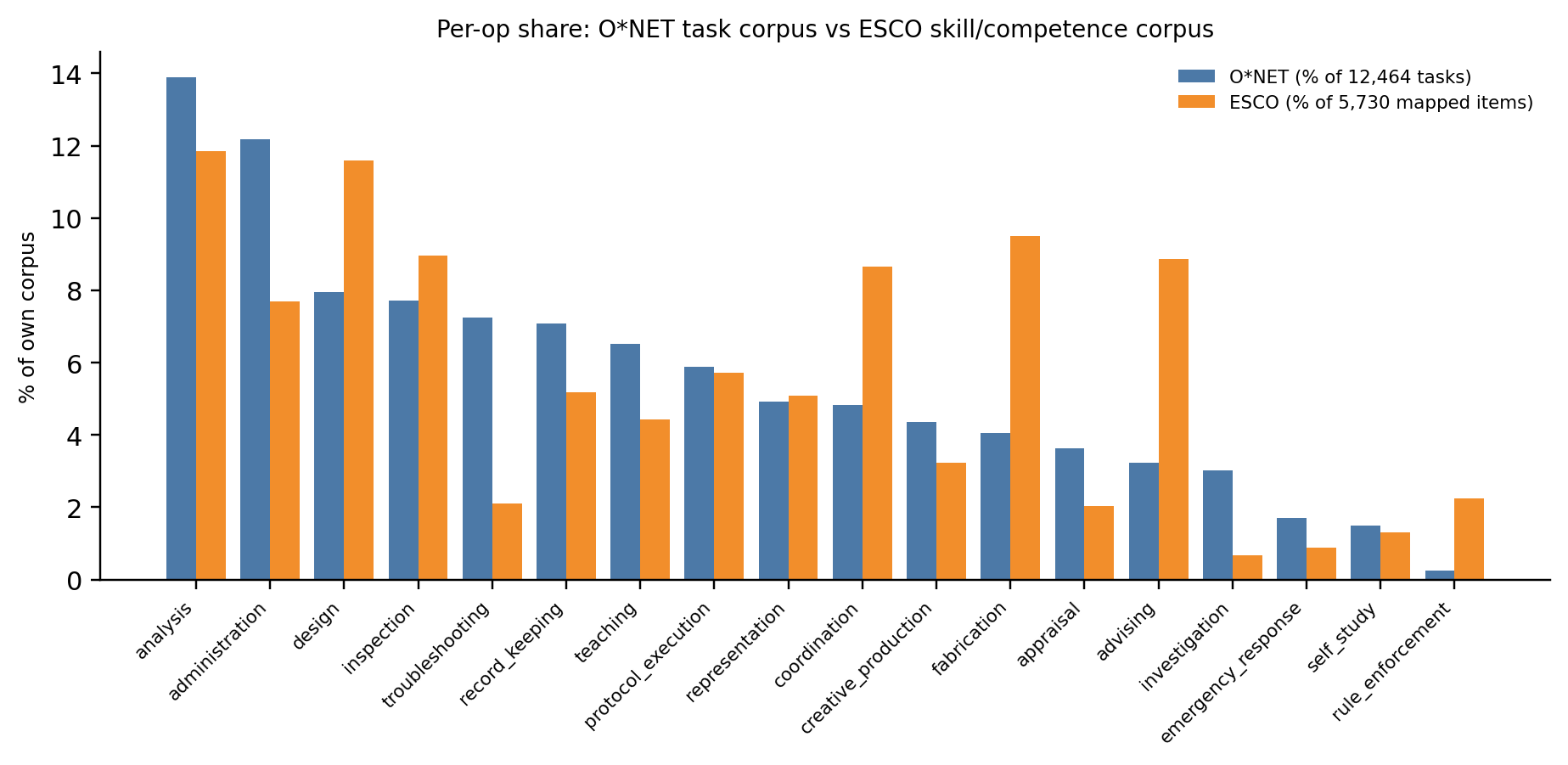
ESCO is used for comparison rather than derivation. The comparison keeps the O*NET-derived taxonomy fixed and applies the work-activity labels to ESCO items to check whether the activity distribution remains interpretable across sources.
In the ESCO check, 5,730 of 5,826 scoped skill and competence items map to one of the 18 work activities. The remaining 96 items are outside the inventory, often because they describe personal traits, subject knowledge, perceptual abilities, or language proficiency rather than work activities.
Implications and Limitations
The results show broad coverage across recurring knowledge-work activities and uneven representation across source corpora. O*NET emphasizes task-inventory activities such as analysis, administration, troubleshooting, inspection, and record-keeping. ESCO gives larger shares to transferable competences such as advising, fabrication, coordination, design, and rule-enforcement.
The main limitation is source comparability. O*NET task statements and ESCO skill and competence items do not describe work at the same level of granularity, so their shares should be read as a corpus-shift check rather than as a pooled estimate. The atlas is also a visualization aid, not a causal model, a labor-market weight, or a measure of occupational importance.
Method
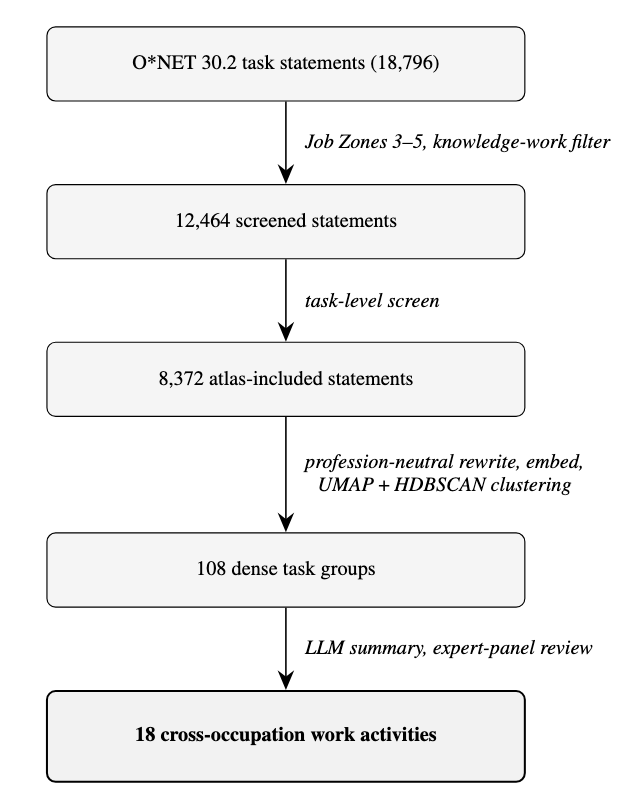
The experiment starts from O*NET 30.2 task statements in Job Zones 3-5 and knowledge-work occupations. After screening, the reporting corpus contains 12,464 task statements. Each retained row carries the O*NET-SOC code, occupation title, task identifier, cleaned task text, importance score, relevance score, and Job Zone.
Screening uses iterative GPT-5.5 classification with author adjudication. Exclusion categories are developed from three independent 100-task samples drawn without replacement. The final exclusion list covers 12 categories, including direct-manual, performative, and routine-clerical work and their sub-variants.
A stricter atlas-inclusion screen is then applied to the 12,464-task reporting corpus. It removes 4,092 statements and retains 8,372 statements for profession-neutral rewriting, embedding, UMAP projection, HDBSCAN clustering, and expert-panel consolidation. The 18 final labels are applied back to the full 12,464-task screened corpus, so the table counts cover the reporting corpus while the atlas visualizes the stricter clustering subset.
The retained atlas tasks are rewritten into profession-neutral work-activity phrases under a fixed prompt to reduce domain vocabulary. The rewritten phrases are embedded into a 1,536-dimensional space and L2-normalized. UMAP uses 15 dimensions, 30 neighbors, and cosine metric. HDBSCAN uses minimum cluster size 30, minimum samples 10, and excess-of-mass extraction, yielding 108 dense task groups.
Four rounds of LLM summarization and expert-panel review consolidate the 108 groups. Rounds 1-3 produced 38, 39, and 16 top-level work activities and were rejected. Round 4 produced the 18 single-concept work activities used in the table and atlas, including the split of an earlier compliance-analysis label into inspection and investigation.
ESCO is processed only after the O*NET taxonomy is fixed. The ESCO inputs are the v1.1.1 English CSV release, including the Skills pillar, Occupations pillar, ISCO groups table, and occupation-skill relations. The scope filter keeps skill or competence items essential-linked to at least one ISCO-08 group 1, 2, or 3 occupation, giving 5,826 items. These items are assigned to the same 18 labels or to a none-of-the-above category using the frozen label definitions.